Regression Vs Sanity Vs Smoke Testing
Difference between regression, sanity and smoke tests
What is a software build?
In software development, a build is a set of executable code ready either for testing or deployment. A software can contain thousands of source code files depending on its sophistication. When the project reaches a certain stage of development, these files are compiled into standalone applications that can be tested and shipped.
The main focus of smoke testing is identifying and testing the important features and not the entire application, as in the example below.
Assume a project for a mobile banking application, which includes features such as:
- Login/Verify Pin
- Transfer Money
- Change Pin
- Display Customer Name
- Provide Bill
- Show Balance
The standard process is illustrated below.
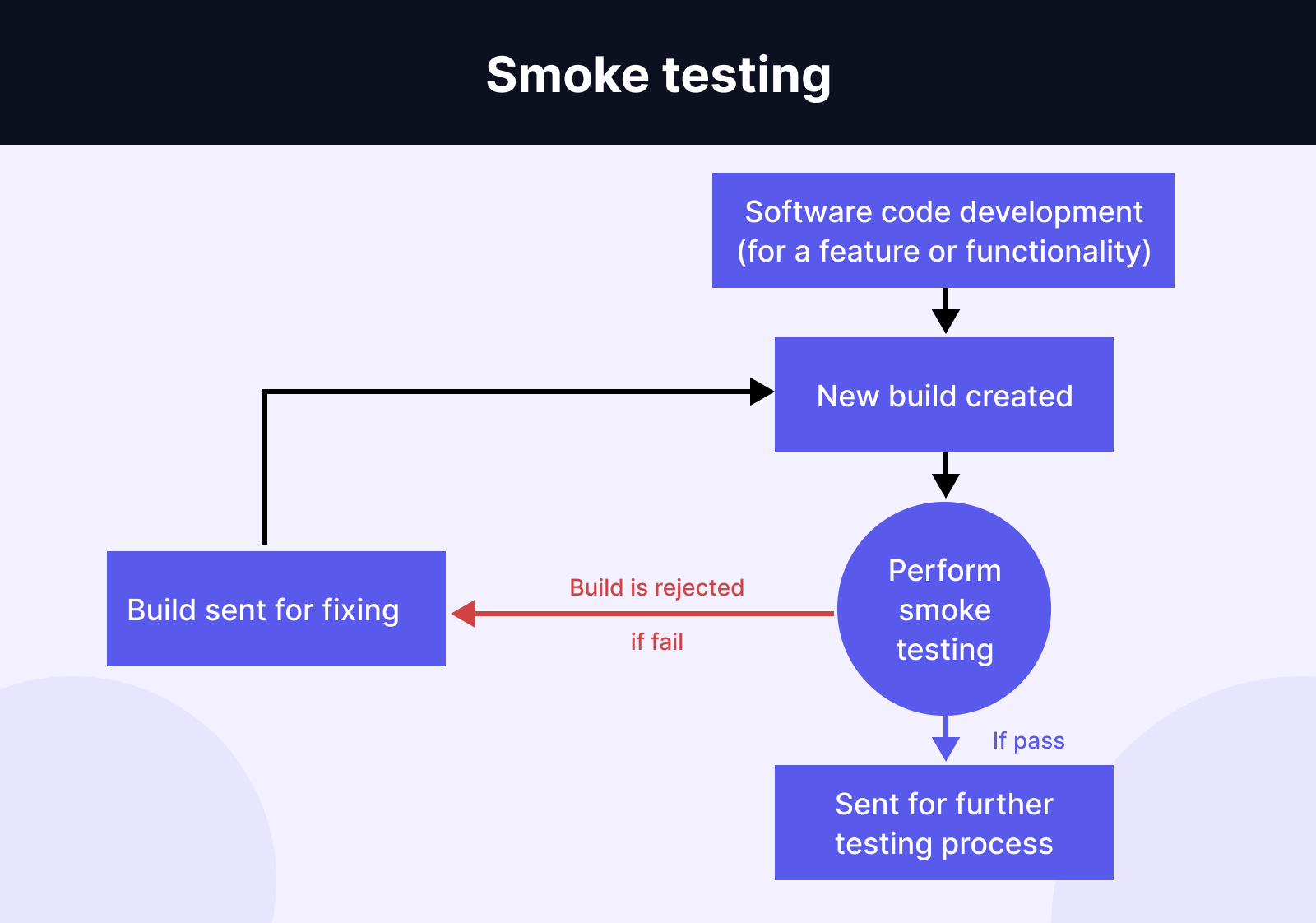
To achieve the best results when executing smoke testing, it is essential to follow these common practices:
- Schedule smoke test suite on CI pipelines to automatically run when a new build is added
- Test early and regularly to assure the stability of the code build in every sprint
- Choosing the fitted testing method based on the requirements and resources of your project. If the budget is limited, a hybrid or an automated approach might be more optimal compared to conducting it all manually
- Early bug troubleshooting: It quickly evaluates the essential features at the initial stages of the project for earlier corrections
- Time and resources efficiency: Smoke test verifies the stability of a delivered build to avoid any QA efforts that may otherwise be wasted
- Reduction of regression issues: Newly introduced build is first tested to reduce the major flaws that can break the integration with the original material
- Automation potential: Automated smoke testing can significantly reduce testing time. Applying automation with an AI-based platform facilitates faster feedback and continuous testing

Sanity testing is executed before the production deployment and after the build is delivered with minor code changes, to fulfill the below objectives:
- Validate critical functionalities and evaluate newly added ones
- Ensure the introduced changes don’t clash with the current functionalities
- Test rational and logical implementations of developers
Features of sanity testing
Some major features of sanity tests are:
- Quick and simple: They are easily designed and performed with the aim to receive quick feedback
- Narrow and deep: One or few functionalities are covered in depth
- Undocumented and unscripted: In general, sanity testing doesn’t require test scripts or test cases
- Performed by testers: Usually, testers are the ones performing sanity testing
Advantages of sanity testing
- Speedy evaluation: It identifies defects in lesser time due to the unplanned and intuitive approach on limited functionalities
- Save time and effort: It acts as a gatekeeper by determining if the application should be further tested or not, which saves time of rigorous regression tests in case the release is in poor condition
- Less cost-intensive: Compared to other types of testing, sanity testing is usually cost-effective
- Identify deployment issues: Sanity tests can early detect compilation problems that may arise if the basic functionality is not working fine, or the previous bugs still exist but done from the developer’s end
Disadvantages of sanity testing
- Limited coverage: It only covers few functionalities, which leaves room for error in the unchecked ones
- Lack of future reference: As it is often carried out without script or documentation, future references are not available
- Time inefficiency in small projects: It takes more time to verify specific components than to check the whole application at once
Smoke testing | Sanity testing | Regression testing |
Executed on initial/unstable builds | Performed on stable builds | Performed on stable builds |
Verifies the build of critical components | Checks the rationality of new module additions or code changes | Tests the functionality of all areas impacted by any code change |
Covers end-to-end essential functionalities | Covers few certain modules of the software | Extensively examines mostly all the functionalities |
Can be employed by both testers and developers | Carried out by testers | Mainly used by testers |
A subset of acceptance testing | Part of regression testing | Superset of regression testing |
Done when there is a new build | Only carried out in short times | Usually performed after each update |
- Sanity is considered surface-level testing with a shallow and broad approach. Meanwhile, regression testing is extensive and in-depth.
- Sanity testing doesn’t use scripts while regression testing asks for scripts and documentation.
- Sanity testing is usually carried out manually but regression testing is preferred to be automated.
Smoke testing vs regression testing
- As smoke testing only focuses on certain modules and is performed on unverified builds, it doesn’t consume too much time and resources. On the other hand, regression testing requires a lot of time, resources, and effort.
- If the build doesn’t pass smoke testing, the application is prevented from further testing. In the case of regression testing, any issues found will not hinder the testing process
Sanity testing vs smoke testing
- Both smoke and sanity testing aim to provide quick feedback on the overall quality of the software, allowing developers to make necessary adjustments before proceeding to more extensive testing.
- The main objective of smoke testing is to test the stability of the build, while that of sanity testing is to verify the rationality of application components.
- Smoke testing is usually well-planned with scripts and documentation. In contrast, sanity testing is not a planned test and is done when time falls short.
FAQs about sanity testing
Why is sanity testing a subset of regression testing?
The relationship between sanity testing, smoke testing, and regression testing can be seen in the graph below.

Yes, regression testing is performed after executing sanity tests of any modified or added functionality. It ensures an application still works as expected after any code changes, updates, or improvements. It determines whether or not the software is eligible for further functional validation.

Therefore, automation has become a critical element in software development practices. With an automated regression testing process, product teams can receive informative feedback and respond more promptly. Finding the right automation solution can take your regression testing to higher levels.

Comments
Post a Comment